What Is Multimodal Transportation?
Multimodal transportation combines two or more transport modes to complete a single cargo movement, coordinated as one connected journey rather than a series of separate bookings.
A typical import shipment might follow this route:
Supplier → Road → Port → Sea → Rail/Road → Warehouse
Under India’s international multimodal transport framework, the movement is legally defined as carriage by at least two different modes — with one being waterborne under a single document that covers the goods from the point they’re accepted to their final destination.
The right combination of modes depends on cargo type, origin, destination, delivery timeline, shipment volume, available infrastructure, and cost.
How Does Multimodal Transportation Work?
A multimodal shipment generally moves through four connected stages.
1. Cargo Pickup
The shipment is collected from the supplier, manufacturer, or warehouse. Road transportation usually handles this first-mile leg since trucks can reach locations without direct rail or port access.
2. Transfer to Another Transport Mode
Cargo moves to a terminal, port, rail facility, or airport. Coordination at this stage matters — poor handoffs create waiting time and unnecessary handling.
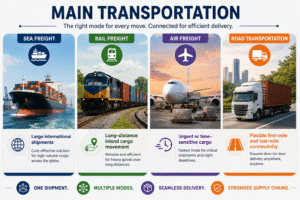
3. Main Transportation
The primary mode is chosen based on shipment requirements:
- Sea freight – large international shipments
- Rail freight – long-distance inland cargo movement
- Air freight – urgent or time-sensitive cargo
- Road transportation – flexible first-mile and last-mile connectivity
4. Final-Mile Delivery
Road or another suitable mode carries the cargo the rest of the way to its destination.
The goal isn’t to use as many modes as possible — it’s to coordinate the right combination for that specific shipment.
What Are the Main Modes of Multimodal Transportation?
|
Transport Mode |
Common Use |
| Road |
First-mile, last-mile, and flexible door-to-door movement |
|
Rail |
Long-distance inland freight movement |
|
Sea |
High-volume domestic and international cargo |
|
Air |
Urgent and time-sensitive shipments |
| Inland Waterways |
Cargo movement where navigable waterways exist |
India’s integrated transport approach treats these modes as complementary rather than competing — road connectivity, for example, typically provides the first or last mile for rail freight movement.
What Are the Benefits of Multimodal Transportation?
1. Better Route Flexibility
Businesses aren’t limited to one mode. Depending on the shipment, cargo can move through different combinations of road, rail, sea, air, and waterways — particularly useful when connecting ports to inland manufacturing, distribution, or consumption centres.
2. Potentially Lower Transportation Costs
Using the right mode for each leg of a journey can help control overall logistics costs for example, road transport for first- and last-mile connectivity paired with rail or sea for the longer haul.
That said, multimodal transportation is not automatically cheaper for every shipment. First-mile and last-mile requirements, terminal handling, and transshipment costs all affect the real economics. A recent Indian government logistics cost assessment found multimodal transportation becomes more economical than pure road transport on longer routes, while road transport often remains preferable for shorter or more specific movements because of its door-to-door flexibility.
3. Improved Supply Chain Connectivity
A shipment can move from a manufacturing facility by road, travel by rail or sea over a longer distance, and continue by road to its final destination creating more options for businesses managing complex domestic or international supply chains.
4. Better Use of Transport Infrastructure
Combining modes strategically makes better use of available roads, railways, ports, terminals, and waterways. India’s PM GatiShakti National Master Plan is specifically built around interconnected, multimodal transportation networks to support this kind of integrated infrastructure development.
5. Greater Reach to Inland Destinations
Ports and airports can’t directly serve every manufacturing facility or distribution centre. Road and rail networks bridge that gap — a key consideration for importers and exporters whose cargo needs to move between ports and locations far from the coast.
6. More Flexible Logistics Planning
Businesses can evaluate mode combinations against delivery deadlines, cargo volume and characteristics, route availability, transportation costs, port and terminal connectivity, and first-/last-mile requirements — making planning far more responsive to individual shipment needs.
Why Is Multimodal Transportation Important for Indian Supply Chains?
India’s manufacturing centres, ports, consumption markets, and distribution hubs are spread across a large and varied geography a single transportation mode rarely offers the most practical route between two points.
The government continues to invest in the infrastructure this depends on. In July 2026, the Ministry of Road Transport and Highways highlighted the development of Multi Modal Logistics Parks, intermodal stations, and other connectivity initiatives as part of building a more integrated transport ecosystem and improving India’s logistics competitiveness. The National Logistics Policy and related initiatives have similarly focused on digital integration, logistics efficiency, and multimodal transport development.
For businesses, the practical value lies in connecting these networks effectively — not just picking a mode.
How Does Multimodal Transportation Help Importers and Exporters?
Import and export shipments typically move through several stages. An export shipment might look like:
Factory → Road → Port → Sea → Destination Port → Road → Customer
An import shipment might follow:
Overseas Supplier → Sea → Indian Port → Rail/Road → Warehouse
The right combination depends on cargo type, destination, urgency, shipment volume, and overall logistics requirements. For EXIM businesses, effective coordination between modes often managed through end-to-end EXIM logistics services helps reduce unnecessary delays and makes origin-to-destination movement easier to manage.
Multimodal vs. Unimodal Transportation
|
Factor |
Unimodal Transportation | Multimodal Transportation |
| Transport modes | One |
Two or more |
| Route flexibility | Generally lower |
Generally higher |
|
Coordination |
Simpler |
Requires coordination across modes |
|
Infrastructure |
Depends on one mode |
Uses multiple transport networks |
|
Best suited for |
Straightforward movements |
Complex or longer supply chains |
Multimodal transportation isn’t automatically the best option for every shipment. A simple point-to-point movement may still be better served by a single mode if it delivers the required cost, speed, and connectivity for example, choosing between FCL and LCL shipping for a straightforward sea freight movement.
Multimodal vs. Intermodal Transportation: What’s the Difference?
The terms multimodal and intermodal are often used interchangeably in general logistics conversation, but their meaning can shift depending on legal and operational context.
Multimodal transportation generally refers to coordinating two or more modes under one overall transportation arrangement in India’s international multimodal transport framework, this movement is covered by a single multimodal transport contract or document. Intermodal transportation also involves multiple modes, but the term is more often used to describe cargo moving through different modes while staying in the same loading unit of a container, for instance throughout the transfers.
Because terminology varies across markets, businesses should always confirm the contractual structure, documentation, and responsibilities tied to a specific shipment.
When Should a Business Use Multimodal Transportation?
Multimodal transportation is worth considering when:
- Cargo needs to travel a long distance
- The origin or destination has limited direct connectivity
- A combination of modes can improve overall efficiency
- Large volumes need to move between ports and inland locations
- Businesses want more route flexibility
- A shipment requires coordinated first-mile, main-haul, and last-mile transportation
- Import or export cargo needs to connect multiple logistics hubs
The decision should always rest on the complete logistics requirement not on transportation mode alone.
How to Choose the Right Multimodal Transportation Solution
Cargo type: Consider nature, dimensions, weight, value, and handling requirements.
Shipment volume: Large-volume shipments may benefit from different mode combinations than smaller consignments.
Destination: Check the availability of ports, rail terminals, highways, warehouses, and other infrastructure along the route.
Delivery timeline: Urgent cargo may need air or faster road connectivity, while non-urgent, high-volume shipments can lean more on sea or rail.
Total logistics cost: Compare the complete cost, not just the freight rate of a single mode including transportation, handling, terminal, and documentation charges.
First-mile and last-mile connectivity: A multimodal plan only works if cargo can move efficiently into and out of the main transportation network.
Visibility and coordination: Consider how shipment status, documentation, transfers, and exceptions will be managed across every stage.
What Are the Common Challenges of Multimodal Transportation?
Coordinating several modes creates its own set of challenges:
- Delays during transfers between modes
- Terminal and port congestion
- Documentation requirements
- Poor first-mile or last-mile connectivity
- Lack of shipment visibility
- Coordination between different logistics stakeholders
- Route disruptions
- Additional handling or transshipment requirements
This is why multimodal logistics needs careful planning rather than simply stacking two or more transport modes together a well-run 3PL logistics partner typically owns this coordination on the business’s behalf.
How Can Businesses Improve Multimodal Logistics Efficiency?
- Plan the complete route before shipment execution.
- Compare total landed logistics costs rather than individual freight rates.
- Select transport modes according to cargo and delivery requirements.
- Plan first-mile and last-mile connectivity in advance.
- Coordinate documentation before cargo reaches transfer points.
- Monitor shipment milestones across every transport stage.
- Work with experienced logistics partners for complex movements including bonded warehousing and FTWZ support where duty deferment or re-export flexibility is needed.
The goal is a connected logistics plan where every stage supports the next.
Why Multimodal Logistics Is Becoming More Important in India
India’s logistics ecosystem is moving toward tighter integration between road, rail, ports, waterways, and other infrastructure. Government initiatives such as PM GatiShakti and the development of Multi Modal Logistics Parks reflect this push toward connected transport infrastructure, and recent government information also points to inland waterways playing a growing role as an alternative to road and rail where navigable routes exist.
For Indian businesses, this creates room to design logistics networks around the strengths of different modes instead of depending on one for the entire journey, often through a single freight forwarding partner who can coordinate the full route.
Multimodal transportation moves a shipment through two or more transport modes: road, rail, sea, air, or waterways under one coordinated logistics plan. It offers better route flexibility, stronger supply chain connectivity, and greater reach to inland destinations, but it isn’t automatically cheaper: first-mile, last-mile, and transshipment costs all factor into the real economics. It’s best suited to long-distance, high-volume, or inland-connected shipments, while simple point-to-point movements may still be better served by a single mode. Choosing the right combination comes down to cargo type, volume, destination, timeline, and total logistics cost and it’s usually best planned with an experienced EXIM transport partner.
Frequently Asked Questions About Multimodal Transportation
What is multimodal transportation?
Multimodal transportation is the movement of goods using two or more transportation modes as part of a coordinated logistics journey, involving combinations of road, rail, sea, air, or inland waterways depending on the shipment.
What are the benefits of multimodal transportation?
The main benefits include greater route flexibility, improved connectivity, better use of transport infrastructure, and potential cost efficiencies. The actual benefit depends on distance, cargo type, route, handling requirements, and first- and last-mile costs.
How does multimodal transportation work in India?
A shipment may move by road from a factory to a rail terminal or port, continue by rail or sea, and then use road transportation for final delivery. The exact combination depends on the shipment’s origin, destination, and logistics requirements.
Is multimodal transportation cheaper than road transportation?
Not always. It can be more economical for certain long-distance movements, but additional first-mile, last-mile, terminal, and transshipment costs can affect the total price. The best option should be chosen after comparing the complete logistics cost.
What is the difference between multimodal and intermodal transportation?
Both involve multiple transport modes. Multimodal transportation generally refers to a coordinated movement across multiple modes, while intermodal is often used for movements where cargo remains in the same loading unit during transfers. The exact distinction can depend on the contractual and operational context.
Which transport modes can be used in multimodal logistics?
Multimodal logistics can involve road, rail, sea, air, and inland waterways, selected according to cargo characteristics, distance, delivery requirements, infrastructure, and cost.
How does multimodal transportation help importers and exporters?
It connects factories, warehouses, ports, airports, and inland destinations through coordinated transport modes, giving importers and exporters greater flexibility when planning international cargo movement.
What factors affect multimodal transportation costs?
Costs depend on cargo weight and volume, distance, selected transport modes, first- and last-mile movement, terminal handling, transshipment, documentation, storage, and route conditions.
How do I choose a multimodal logistics provider in India?
Look for a provider with experience coordinating multiple transport modes, strong domestic and international connectivity, appropriate documentation capabilities, shipment visibility, and the ability to manage first-mile, main-haul, and last-mile requirements logistics consultancy support can help evaluate this before committing to a route.
Is multimodal transportation suitable for every business?
No. The best transportation model depends on the shipment. Some point-to-point movements may be more efficient with a single transport mode, while complex, long-distance, or international shipments may benefit from a multimodal approach.
Conclusion
Multimodal transportation is more than using multiple modes of transport it’s about connecting those modes into one efficient, coordinated movement of goods. For Indian businesses, the right combination of road, rail, sea, air, and waterways can open up greater flexibility and a wider logistics network, but the best solution always depends on cargo requirements, route, delivery timeline, infrastructure, and total logistics cost.
As India’s transport infrastructure grows more interconnected, businesses that plan their supply chains around the strengths of different transport modes will be better positioned to manage complex domestic and international cargo movements ideally with an experienced logistics partner evaluating the route, modes, connectivity, and operational requirements before execution.