FCL vs LCL Shipping in India: Which Option Is Right for Your Cargo?
Last Updated: April 2026 | Reading Time: 8 Minutes
If you have ever booked an international shipment from India, someone has asked you this question: FCL or LCL? And if you did not know what to say, you are not alone. Most importers and exporters in India — even experienced ones — make this decision based on habit or gut feel rather than actual data.
That costs them money. Sometimes a lot of it.
This guide breaks down FCL vs LCL shipping in India in plain language — what each option means, when to use which, how they compare on cost and transit time, and the mistakes businesses make when choosing wrong. Whether you are shipping out of JNPT Mumbai, Chennai, or any other Indian port, this guide will help you make the right call every time.
What Is FCL Shipping?
FCL stands for Full Container Load. It means you are booking an entire shipping container — a 20-foot (20GP) or 40-foot (40GP/40HC) — exclusively for your cargo. No other shipper’s goods share the container with yours.
You pay for the full container regardless of how much space your cargo actually uses. In return, you get faster transit, lower risk of damage, and no dependency on other shippers’ timelines.
FCL is typically the right choice when your cargo fills more than 15–18 CBM (cubic metres), or when you are shipping fragile, high-value, or time-sensitive goods that cannot afford delays caused by consolidation.
What Is LCL Shipping?
LCL stands for Less than Container Load. Your cargo is grouped — or consolidated — with goods from other exporters into one shared container. You pay only for the space your cargo occupies, typically measured in CBM or freight tonnes, whichever is higher.
LCL is managed by a consolidator, often a freight forwarding company, who combines multiple smaller shipments into a single full container, ships it to the destination port, and then separates and delivers each shipper’s goods individually. This process is also called groupage shipping or cargo consolidation.
LCL works best when your cargo is under 10–12 CBM, or when you are a small or mid-size exporter who cannot justify the cost of an entire container.
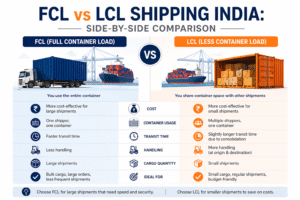
FCL vs LCL Shipping India: Side-by-Side Comparison
Here is a direct comparison of both options across every factor that matters to Indian importers and exporters:
|
Factor |
FCL (Full Container Load) |
LCL (Less Than Container Load) |
|
Meaning |
You book the entire container exclusively | Your cargo shares a container with other shippers |
|
Best For |
Large shipments of 15 CBM or more | Small shipments under 12 CBM |
| Cost Structure | Fixed rate per container |
Rate per CBM or freight tonne |
|
Transit Time |
Faster — direct port-to-port movement | Slower — consolidation and deconsolidation add 5–10 days |
|
Cargo Safety |
Higher — no third-party handling | Moderate — multiple handling points increase risk |
| Flexibility | Lower — need to fill or justify the container |
Higher — ship any quantity at any time |
|
Damage Risk |
Lower | Higher — cargo is handled multiple times |
| Customs Clearance | Faster and simpler — dedicated examination |
Risk of delay if another shipper’s cargo is flagged |
|
Ideal For |
Manufacturers, large exporters, bulk shippers | SMEs, startups, sample shipments, trial orders |
| Documentation | House BL and Master BL, or direct BL |
House BL issued through the consolidator |
FCL vs LCL Cost Comparison in India
This is where most businesses get confused. The answer is not as simple as “FCL is always cheaper for big cargo.” It depends on your cargo volume, the trade lane, and the freight market at the time of booking.
For shipments under 5 CBM, LCL is almost always the right choice — the cost of booking even a 20-foot container cannot be justified. The same applies to shipments between 5 and 10 CBM, where LCL consolidation rates from Indian ports like JNPT remain highly competitive.
The picture changes between 10 and 15 CBM. This is what logistics professionals call the break-even zone. At these volumes, the per-CBM rate of LCL becomes comparable to what you would pay per CBM for a 20-foot FCL container. If your cargo regularly falls in this range, it is worth getting quotes for both options before booking rather than assuming one is cheaper.
Once your cargo exceeds 15–20 CBM, FCL almost always wins — both on cost per CBM and on transit time. A 20GP container from JNPT Mumbai typically costs between ₹45,000 and ₹90,000 depending on the destination, while LCL at 18 CBM can land at a similar or higher total after CFS charges and documentation fees are added.
Our freight forwarding team recommends always getting live quotes for both options if your shipment sits in the 10–15 CBM range, as freight rates fluctuate significantly by season and trade lane.
FCL vs LCL Transit Time: What You Need to Know
Transit time is one of the most underestimated differences between the two options, and it catches a lot of exporters off guard.
With FCL, your container moves directly from the origin port to the destination port. Once it arrives, customs clearance and delivery begin immediately. The process is clean and predictable.
With LCL, there are two additional stages: consolidation at the origin Container Freight Station (CFS) before departure, and deconsolidation at the destination CFS after arrival. The deconsolidation process alone typically adds 2–5 working days after the vessel arrives. Combined with the time needed for consolidation at origin, LCL shipments generally take 5–10 working days longer than FCL on the same trade lane.
If your buyer has a firm delivery deadline, or if your cargo is seasonal, perishable, or demand-driven, FCL is almost always the better choice — not because of volume, but because of speed and reliability.
When Should You Choose FCL?
FCL is the right option when your cargo volume exceeds 15 CBM, but volume is not the only reason to choose it. If you are shipping fragile or high-value goods, the absence of third-party handling in FCL significantly reduces the risk of damage and theft. Cargo that requires temperature control — pharmaceuticals, food products, chemicals — must be shipped in reefer FCL containers, as LCL reefer services are limited and expensive.
FCL also makes sense when your cargo is confidential or branded, since LCL co-loading means your goods travel alongside unknown shippers. And if you ship regularly in high volumes, FCL contracts with shipping lines can bring your per-shipment rate down substantially over time.
Our EXIM transport team regularly advises clients in manufacturing, automotive, and pharma to review their LCL spend once monthly volumes cross the break-even threshold — the annual savings on switching to FCL can be significant.
When Should You Choose LCL?
LCL is not the second-best option. For the right business and shipment size, it is the smart one.
If your cargo is under 10–12 CBM, you are paying for empty container space with FCL — and that is simply unnecessary. LCL lets you ship exactly what you have, exactly when you have it, without waiting to accumulate enough goods to fill a container.
LCL is particularly well-suited for first-time or trial shipments, where you are testing a new buyer or a new market without committing to large volumes. It works well for start-up exporters who need to keep cash flow tight, and for businesses with multiple SKUs being shipped in small quantities to the same destination.
LCL consolidation from JNPT Mumbai is mature and well-served, with weekly sailings to major global destinations including Singapore, Dubai, Rotterdam, Felixstowe, and Los Angeles. A reliable freight forwarding partner in Mumbai will give you access to these routes at competitive all-in rates.
The Hidden Costs of LCL You Should Know About
When comparing FCL vs LCL shipping costs in India, most businesses only look at the base freight rate. But LCL comes with additional charges that can erode the cost advantage if you are not careful.
At the origin end, Container Freight Station (CFS) handling charges typically add ₹3,000 to ₹8,000 per shipment. The consolidator will also charge documentation fees for issuing the House Bill of Lading, usually between ₹1,500 and ₹3,500. At the destination, CFS destuffing and handling charges apply in addition to standard customs fees.
There is also the matter of risk. With LCL, your cargo is handled multiple times — at the origin CFS, during loading, during deconsolidation, and at final delivery. Each handling point is a potential point of damage. Insurance premiums for LCL shipments are accordingly higher than for FCL.
Finally, there is the customs examination risk. If another shipper’s cargo in your consolidated container is flagged for examination or found to have a documentation problem, your entire container can be held at the destination port. This is out of your control entirely, but it adds real uncertainty to LCL delivery timelines. Working with an experienced customs broking team ensures that your own documentation is airtight — which is the only part of this risk you can actually manage.
FCL Container Types: A Quick Guide for Indian Exporters
If you choose FCL, picking the right container type matters. The most common options for Indian exporters are the 20GP (20-foot General Purpose), which offers approximately 25 CBM of space and is suited for heavier, denser cargo, and the 40HC (40-foot High Cube), which provides around 76 CBM and works well for lightweight, bulky goods.
For temperature-sensitive cargo such as pharmaceuticals, fresh produce, or chemicals, a reefer container — available in both 20-foot and 40-foot sizes — is mandatory. For machinery, vehicles, or over-dimensional cargo, open top or flat rack containers are used.
Your freight forwarding partner will recommend the appropriate container type based on your cargo’s dimensions, weight, and handling requirements.
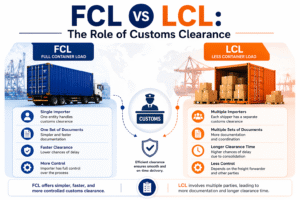
FCL vs LCL: The Role of Customs Clearance
Customs clearance is one area where FCL has a clear and often overlooked advantage.
With FCL, customs authorities examine your container as a single dedicated unit. The Bill of Entry is filed for your cargo alone, and any query or examination is limited to your shipment. The process is predictable and contained.
With LCL, the picture is more complex. If another shipper’s goods in the same consolidated container are flagged during examination, your cargo can be held at the destination port — even when your documentation is completely correct. This is a genuine risk that adds unpredictability to LCL delivery timelines and can result in demurrage charges that eat into your cost savings.
This is why working with a trusted customs broking team is especially important for LCL shipments. Proper, complete documentation from your side is the most effective way to minimise the impact of third-party delays on your cargo.
For a full breakdown of what documentation is required for international shipments from India, read our freight forwarding process guide.
FCL vs LCL: Quick Decision Guide
| Your Situation |
Recommended Option |
|
Cargo is 15 CBM or more |
FCL |
| Cargo is under 10 CBM |
LCL |
|
Cargo is 10–15 CBM |
Get quotes for both before deciding |
| Delivery deadline is tight |
FCL |
|
Budget is the primary concern and cargo is under 12 CBM |
LCL |
| Fragile or high-value goods |
FCL |
|
First-time or trial shipment |
LCL |
| Temperature-sensitive cargo |
FCL (Reefer container) |
|
Regular monthly shipments above 20 CBM |
FCL with contract rates |
| Multiple small SKUs to one destination |
LCL |
Frequently Asked Questions (FAQs)
Q1: What is the difference between FCL and LCL shipping in India?
FCL (Full Container Load) means your cargo occupies an entire container exclusively. LCL (Less than Container Load) means your cargo is consolidated with other shippers’ goods in a shared container. FCL is faster and offers greater cargo safety. LCL is more cost-effective for smaller shipments and gives you the flexibility to ship any quantity without waiting to fill a container.
Q2: Which is cheaper — FCL or LCL shipping from India?
It depends on your cargo volume. LCL is cheaper for shipments under 10–12 CBM. FCL becomes cost-competitive — and often cheaper per CBM — once your cargo crosses 15 CBM. The 10–15 CBM range is the break-even zone, and you should get quotes for both options before deciding.
Q3: How much does LCL shipping cost from India?
LCL base freight rates from Indian ports typically range from ₹800 to ₹2,500 per CBM depending on the destination, shipping line, and season. CFS handling charges, documentation fees, and destination-end charges apply on top of the base rate. Always request an all-in quote from your freight forwarder to get an accurate total cost.
Q4: How long does LCL shipping take compared to FCL from JNPT Mumbai?
LCL typically adds 5–10 working days to transit time compared to FCL on the same trade lane. The additional time comes from consolidation at the origin CFS before departure and deconsolidation at the destination CFS after the vessel arrives. FCL moves port-to-port without these additional stages.
Q5: Can I ship hazardous goods via LCL from India?
Some categories of hazardous goods can be shipped LCL, but many cannot. Hazardous cargo has strict co-loading restrictions, and most consolidators will not accept certain DG (Dangerous Goods) classes in a shared container. FCL is the safer and often the only viable option for hazardous shipments. Contact our logistics consultancy team before booking DG cargo.
Q6: What documents are required for FCL and LCL shipments from India?
Both FCL and LCL require a Commercial Invoice, Packing List, Bill of Lading, Shipping Bill, IEC Code, and a Certificate of Origin where applicable. LCL shipments additionally involve a House Bill of Lading issued by the consolidator alongside the Master Bill of Lading. Read our freight forwarding process guide for a complete documentation checklist.
Q7: Is FCL better than LCL for pharmaceutical exports from India?
Yes, in most cases. Pharmaceutical cargo typically requires temperature control, strict handling procedures, and reliable transit times — all of which FCL manages better than LCL. Reefer FCL containers are the standard for temperature-sensitive pharma exports, and the dedicated nature of FCL eliminates the co-loading and handling risks that come with LCL.
Q8: Who handles LCL consolidation at JNPT Mumbai?
LCL consolidation at JNPT is handled by licensed freight forwarders and consolidators operating at the Container Freight Stations at Nhava Sheva. Bismarck World provides freight forwarding services including LCL consolidation from JNPT, with access to regular weekly sailings to major global destinations including Singapore, Dubai, Rotterdam, and Felixstowe.
Choosing Between FCL and LCL: Work With the Right Freight Partner
The FCL vs LCL decision is not just about volume. It is about your delivery timelines, cargo type, trade lane, budget, and how frequently you ship. The right answer changes from one shipment to the next — and that is exactly why working with an experienced freight forwarding partner matters.
At Bismarck World, we are a trusted logistics company in Mumbai with deep expertise in international freight forwarding, customs clearance, EXIM logistics, and multimodal transport. Whether your cargo is 2 CBM or 200 CBM, we help you choose the most cost-effective and reliable shipping option for every shipment.
Contact us today for a free FCL vs LCL quote on your next shipment from India.
Also Read:
- Freight Forwarding Services in Mumbai — What We Offer
- The Freight Forwarding Process Explained Step by Step
- Customs Broking Services in Mumbai: Complete Guide
- Air Freight Forwarding Services from Mumbai
- FTWZ vs Regular Warehousing: Which Is Right for You?