India’s merchandise exports crossed $437 billion in FY2024, and the country continues to rank among the world’s top 20 trading nations. Behind every shipment is a network of coordinated processes — freight booking, documentation, customs filing, warehousing, and last-mile delivery — that together form what the industry calls EXIM logistics services in India.
Whether you are a manufacturer exporting finished goods, an importer sourcing raw materials, or an eCommerce business serving global customers, understanding how international logistics works is essential to managing costs, avoiding delays, and staying compliant with India’s trade regulations.
This guide covers everything — how EXIM logistics services work, what each stage involves, the common challenges businesses face, and how to choose the right logistics partner for your international trade operations.
What Are EXIM Logistics Services?
EXIM logistics services are end-to-end supply chain solutions that manage the movement of goods across international borders. The term “EXIM” stands for Export-Import, and these services cover every stage from shipment origin to final delivery at the destination country.
A professional EXIM logistics provider typically handles:
- Freight forwarding (air, sea, road, rail)
- Customs clearance and compliance
- Import-export documentation
- Cargo handling and warehousing
- Multimodal transportation
- Shipment tracking and visibility
- Cargo insurance
- Supply chain coordination
The goal is to ensure goods move efficiently, legally, and cost-effectively across borders — without businesses having to manage every individual process themselves.
Why EXIM Logistics Services Matter for Indian Businesses
India’s growing manufacturing sector, the government’s focus on export promotion, and increasing participation in global value chains have all made professional international logistics services more critical than ever.
International shipping is not simply about booking a container. It involves:
- Navigating customs regulations that differ across 190+ countries
- Ensuring correct HS code classification to avoid duty disputes
- Managing port congestion and vessel schedule changes
- Coordinating documentation across multiple agencies
- Staying compliant with India’s DGFT and customs regulations
Without experienced logistics support, even a minor documentation error can result in shipment holds, penalty charges, or missed delivery windows.
Key Benefits of Professional EXIM Logistics Services
Faster Cargo Movement — Efficient shipment planning and carrier coordination reduces transit times and port dwell time.
Customs Compliance — Experienced customs broking professionals ensure correct documentation, HS classification, and duty payment, preventing costly delays.
Lower Transportation Costs — Freight consolidation, route optimization, and carrier negotiations help businesses reduce per-unit shipping costs.
Real-Time Shipment Visibility — GPS tracking and digital freight systems give businesses live updates on cargo location and status.
Scalable Supply Chain Support — As trade volumes grow, professional logistics partners scale operations without disruption.
How Do EXIM Logistics Services Work? (Step-by-Step)
Many businesses entering global trade ask: “How exactly does international logistics work from start to finish?”
Here is a clear breakdown of each stage.
Stage 1 — Shipment Planning and Route Optimization
Every international shipment starts with a planning phase. Logistics experts evaluate:
- Cargo type, weight, and dimensions
- Destination country and port of entry
- Delivery urgency and transit time requirements
- Budget and freight cost constraints
- Applicable customs regulations at origin and destination
Based on this, the right transportation mode is selected — air freight for urgent or high-value cargo, sea freight for bulk or cost-sensitive shipments, or a combination through multimodal logistics solutions.
Stage 2 — Import Export Documentation
Accurate documentation is the foundation of smooth international trade. Errors in paperwork are one of the leading causes of customs delays, shipment rejections, and financial penalties.
Common documents required for India’s export-import operations include:
- Commercial Invoice
- Packing List
- Bill of Lading (sea) or Airway Bill (air)
- Shipping Bill (for exports) / Bill of Entry (for imports)
- Certificate of Origin
- Insurance Certificate
- Import Export Code (IEC) issued by DGFT
- Relevant permits (FSSAI, CPCB, BIS, depending on cargo type)
A professional EXIM transport and logistics partner ensures all documentation is complete, correctly filed, and compliant with both Indian and destination country regulations.
Stage 3 — Freight Forwarding
Freight forwarding services are the operational backbone of international logistics. A freight forwarder acts as an intermediary between the shipper and the carriers (shipping lines, airlines, rail operators), coordinating the actual movement of cargo.
Key tasks handled by freight forwarders include:
- Carrier selection and booking
- Freight rate negotiation
- LCL (Less than Container Load) cargo consolidation
- Shipment documentation preparation
- Transit monitoring and exception management
- Coordination with ports, terminals, and customs
Businesses involved in regular imports or exports benefit significantly from working with an experienced international freight forwarding partner in India who has established carrier relationships and operational expertise at major ports like JNPT (Nhava Sheva) and Mumbai Port.
Stage 4 — Customs Clearance
The customs clearance process is often the most complex and time-sensitive stage of international logistics. Every consignment entering or leaving India must be declared to customs, assessed for applicable duties, and physically or documentarily verified before release.
Key steps in the customs clearance process include:
- Filing of Import General Manifest (IGM) or Export General Manifest (EGM)
- Bill of Entry / Shipping Bill submission
- HS Code classification and duty assessment
- Document verification by customs officers
- Cargo examination (where required)
- Duty payment
- Out-of-charge / Let Export Order issued
Professional customs broking services help businesses navigate this process efficiently — ensuring correct HS codes, accurate duty calculations, and timely document submission to avoid demurrage charges or cargo holds at ports like JNPT.
Stage 5 — Warehousing and Inventory Management
For many businesses, cargo doesn’t move directly from port to customer. Intermediate warehousing is often required — either to consolidate inbound shipments, manage inventory buffers, or enable efficient distribution.
Modern logistics providers offer several warehousing models:
- Bonded Warehousing — For cargo where customs duty payment is deferred until goods enter the domestic market
- FTWZ (Free Trade Warehousing Zone) services — A specialized facility that allows duty deferment, long-term storage, and re-export without full domestic customs clearance — ideal for importers and traders dealing in high-value goods
- General Warehousing — For inventory management, order fulfillment, and distribution support
FTWZ facilities near JNPT are particularly valuable for businesses that import goods for re-export or require flexible storage before distribution across India.
Stage 6 — Inland Transportation and Final Delivery
After customs clearance, cargo moves toward its final destination through road, rail, or a combination of both. Efficient inland logistics is critical to completing the supply chain without delays or added costs.
Rail logistics services have become an increasingly important part of India’s EXIM supply chain, offering cost-effective cargo movement between major ports and inland container depots (ICDs) across the country. Rail freight is particularly suited for bulk cargo and long-distance movement where road transport would be slower or more expensive.
The Role of Multimodal Logistics in India’s EXIM Trade
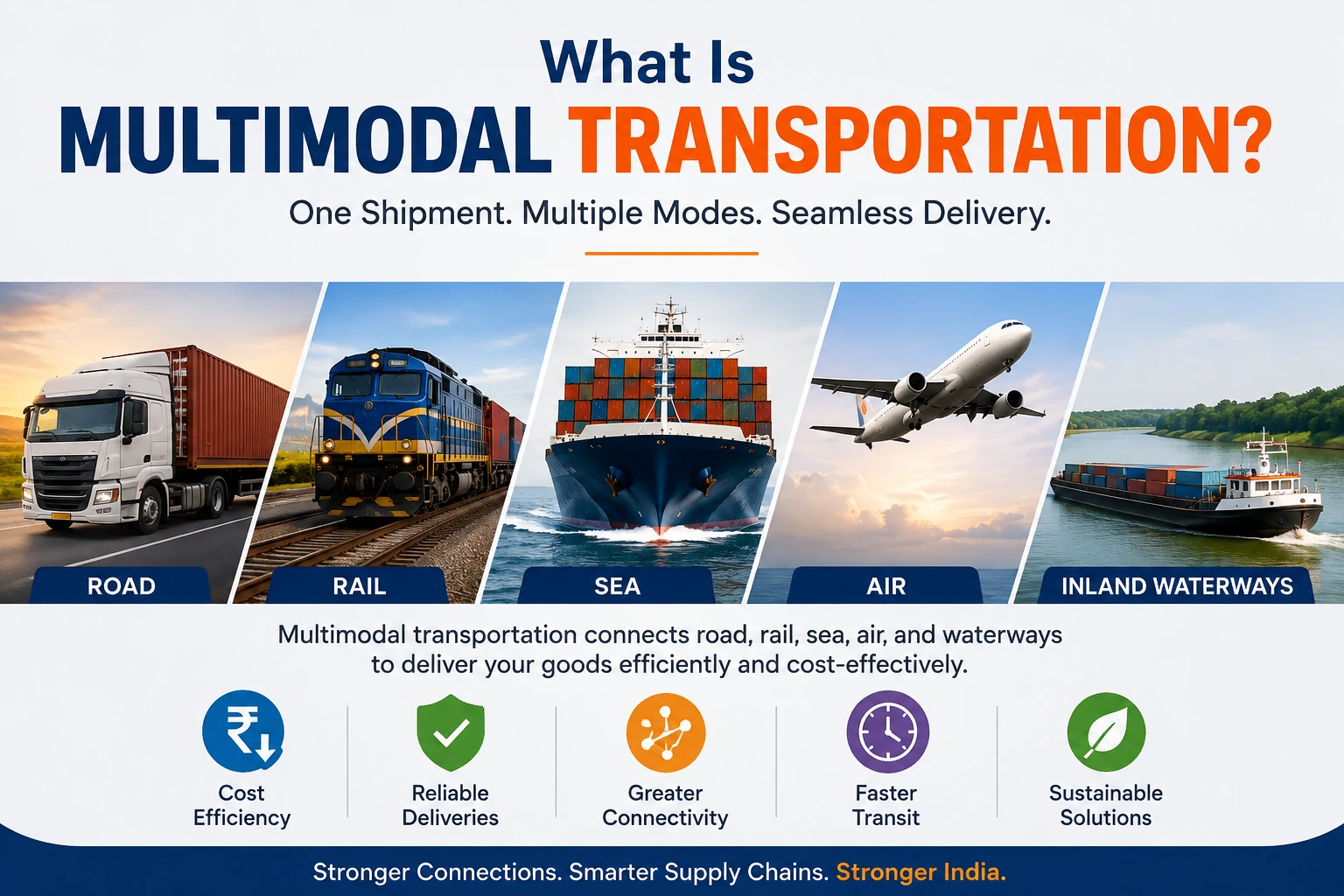
Modern businesses increasingly rely on integrated transportation models that combine two or more modes — road, rail, sea, and air — to optimize cost, speed, and reliability.
Multimodal logistics is particularly effective for India’s complex geography, where cargo often moves from inland manufacturing locations to coastal ports, and then onwards via international shipping routes.
Key advantages of multimodal logistics include:
- Reduced overall freight costs through optimized mode selection
- Better flexibility to handle changes in schedules or routes
- Single-window coordination across multiple carriers
- Lower cargo handling risk due to integrated operations
- Improved delivery reliability
Understanding IEC Registration: A Prerequisite for India’s EXIM Trade
Before any business in India can legally import or export goods, it must obtain an Import Export Code (IEC) from the Directorate General of Foreign Trade (DGFT).
The IEC is a 10-digit code that serves as the primary identification for businesses in all international trade transactions, customs filings, and banking-related foreign exchange settlements.
IEC Registration Benefits:
- Legal authorization to conduct import-export trade
- Mandatory for customs clearance filings
- Required for remittance or receipt of foreign currency
- Enables access to export promotion benefits and duty drawback schemes
- Prerequisite for obtaining RCMC (Registration-Cum-Membership Certificate) from export promotion councils
Businesses seeking logistics consultancy support often require guidance on IEC registration as part of broader trade compliance advisory.
Common Challenges in Import Export Logistics
Despite process improvements and digitization, EXIM logistics in India still involves several operational hurdles that businesses must navigate carefully.
Documentation Errors — Incorrect or incomplete paperwork is the most common cause of customs delays. Even minor discrepancies between the invoice, packing list, and bill of lading can trigger holds.
HS Code Misclassification — Incorrect tariff classification leads to wrong duty assessment, potential penalties, and retrospective audits. This is an area where professional customs broking expertise is critical.
Port Congestion — High cargo volumes, vessel bunching, and berth unavailability at busy ports like JNPT can add days to clearance timelines.
Freight Rate Volatility — Global supply chain disruptions, fuel price changes, and seasonal demand shifts cause significant freight rate fluctuations that impact logistics budgets.
Regulatory Changes — India’s trade policy, customs procedures, and compliance requirements evolve frequently. Staying current requires specialist knowledge.
Lack of Cargo Visibility — Without real-time tracking, businesses struggle to plan downstream operations or communicate accurate ETAs to customers.
These challenges are best managed with the support of an experienced import-export logistics partner that combines operational expertise, technology infrastructure, and regulatory knowledge.
How Technology Is Transforming EXIM Logistics
Digital transformation is reshaping every aspect of international logistics operations:
- AI-powered route optimization — Algorithms analyze thousands of routing combinations to identify the fastest and most cost-effective paths
- Real-time GPS cargo tracking — Shipments are monitored continuously from origin to destination
- Electronic customs filing (ICEGATE) — India’s customs portal enables paperless document submission, reducing processing times
- Digital freight platforms — Online marketplaces for freight booking, rate comparison, and shipment management
- Cloud-based inventory systems — Centralized stock visibility across warehouses and distribution centres
- Blockchain for supply chain transparency — Immutable records of shipment events and document verification
For businesses evaluating logistics consultancy services, understanding the technology infrastructure of a potential logistics partner is increasingly important.
How to Choose the Right EXIM Logistics Partner
Not all logistics providers are equal. Choosing the wrong partner can result in shipment delays, compliance failures, and unexpected costs. Businesses should evaluate potential partners on the following criteria:
Industry Experience — Look for providers with a proven track record in your specific industry (pharmaceuticals, chemicals, automotive, FMCG, etc.) and commodity type.
Customs Expertise — Ensure the provider has licensed Custom House Agents (CHAs) and experience at your relevant ports of entry or exit.
Global Network — Strong partnerships with international shipping lines, airlines, and overseas agents determine the reliability of international shipments.
Technology Infrastructure — Real-time tracking, digital documentation, and online reporting should be standard offerings.
Service Range — End-to-end capabilities including freight forwarding, customs clearance, warehousing and FTWZ, rail logistics, and EXIM transport under one roof, reducing coordination overhead.
Regulatory Knowledge — The partner should provide proactive guidance on trade compliance, duty optimization, and regulatory changes.
Customer Support — Responsive communication and dedicated account management are essential for time-sensitive cargo operations.
Future of EXIM Logistics Services in India
India’s trade ambitions — a target of $2 trillion in exports by 2030 — will drive significant growth in logistics demand. Several trends are shaping the future of EXIM logistics in India:
Infrastructure Development — Expansion of dedicated freight corridors, new port capacity at JNPT and Mundra, and multimodal logistics parks are reducing inland transit times.
PM GatiShakti — The National Master Plan for multimodal connectivity is improving integration between ports, rail, road, and air cargo infrastructure.
Green Logistics — Sustainability requirements from global buyers are pushing logistics providers toward electric vehicles, renewable energy in warehousing, and lower-emission shipping options.
Automated Customs Processing — ICEGATE and SWIFT (Single Window Interface for Trade) are reducing manual interventions in customs clearance.
Real-Time Analytics — Predictive analytics for demand forecasting, freight rate optimization, and risk management are becoming standard in advanced logistics operations.
Businesses that partner with forward-looking logistics companies in India will be better positioned to adapt to these changes and maintain competitive supply chain performance.
Frequently Asked Questions (FAQs)
What are EXIM logistics services in India?
EXIM logistics services in India refer to end-to-end supply chain and transportation solutions that manage the import and export of goods across international borders. These services include freight forwarding, customs clearance, cargo handling, warehousing, multimodal transportation, and shipment documentation — enabling businesses to move goods efficiently between India and global markets.
What is the difference between freight forwarding and customs clearance?
Freight forwarding involves coordinating the physical transportation of cargo — selecting carriers, booking space, consolidating shipments, and managing cargo in transit. Customs clearance is a separate regulatory process that involves filing declarations with customs authorities, paying applicable duties, and obtaining release for goods to enter or exit a country. A full-service EXIM logistics provider handles both.
What documents are required for import export in India?
For exports, key documents include the Commercial Invoice, Packing List, Shipping Bill, Bill of Lading or Airway Bill, Certificate of Origin, and Export Declaration. For imports, the Bill of Entry replaces the Shipping Bill, and additional regulatory permits may be required depending on cargo type. All businesses must hold a valid IEC (Import Export Code) issued by DGFT.
What is an FTWZ and how does it help importers?
A Free Trade Warehousing Zone (FTWZ) is a specially designated area where imported goods can be stored without paying customs duty until they are released into the domestic market. This allows businesses to defer duty payments, manage inventory more flexibly, and re-export goods without full domestic customs clearance. FTWZ services near JNPT are particularly useful for high-value imports and trading companies.
Why is HS code classification important in customs clearance?
HS (Harmonized System) codes are internationally standardized product classification codes that determine the customs duty rate applicable to a shipment. Incorrect HS code classification leads to wrong duty assessment, potential regulatory penalties, and audit risk. Professional customs broking services ensure correct classification based on detailed product specifications.
What is multimodal logistics and why does it matter for EXIM trade?
Multimodal logistics combines two or more transportation modes — such as road, rail, sea, or air — under a single logistics plan. It improves cost efficiency, reduces transit times, and offers greater flexibility for complex supply chains. For Indian businesses exporting from inland locations to international ports, multimodal EXIM transport solutions are particularly valuable.
How do rail logistics services support EXIM operations in India?
Rail logistics services provide a cost-effective and high-capacity solution for moving cargo between inland manufacturing hubs and major seaports. Rail freight is especially suited for bulk cargo and long-distance routes, reducing road congestion and per-tonne transportation costs for EXIM shipments.
How can a logistics consultancy help my import-export business?
A logistics consultancy helps businesses evaluate their current supply chain setup, identify inefficiencies, ensure regulatory compliance, and design better logistics strategies. This can include guidance on IEC registration, duty optimization, FTWZ suitability, carrier selection, and customs procedure improvements.
Conclusion
Effective EXIM logistics management is one of the most important competitive advantages an internationally trading business can build. From the moment a shipment is planned to the point of final delivery, every stage — freight forwarding, customs clearance, warehousing, inland transport — contributes to overall supply chain performance.
India’s growing role in global trade means businesses need logistics partners that combine regulatory expertise, operational infrastructure, global freight networks, and technology capabilities.
Bismarck World provides comprehensive EXIM logistics services in Mumbai, including freight forwarding, customs broking, FTWZ solutions, rail logistics, and logistics consultancy supporting importers, exporters, and global businesses with end-to-end supply chain solutions.
Get in touch with Bismarck World to discuss your EXIM logistics requirements.