In today’s fast-moving global economy, businesses need more than just warehouse space they need logistics solutions that improve efficiency, reduce operational costs, and support seamless international trade. Whether you’re importing raw materials, exporting finished goods, or managing inventory across multiple markets, the right warehousing strategy has a direct impact on profitability and customer satisfaction.
For many businesses, the biggest challenge isn’t transportation, it’s managing customs duties, inventory holding costs, and supply chain complexity. Paying import duties upfront, storing inventory for extended periods, and coordinating cross-border logistics can put pressure on cash flow and slow business growth.
This is where a bonded warehouse in India becomes a valuable asset. By allowing businesses to store imported goods under customs supervision without immediate duty payment, bonded warehouses provide greater financial flexibility and operational control.
As international trade becomes more dynamic, businesses are increasingly combining bonded warehousing with Free Trade and Warehousing Zones (FTWZs). An FTWZ warehouse in India goes beyond storage, offering value-added logistics services such as inventory management, packaging, labeling, distribution, customs facilitation, and export support all within a customs-controlled environment.
This article explains how bonded warehousing and FTWZ facilities complement each other, highlights their key differences, and shows how businesses can use both to strengthen logistics operations and gain a competitive advantage in domestic and international markets.
What is a Bonded Warehouse in India, and how does it differ from an FTWZ?
A bonded warehouse in India is a customs-authorized facility where imported goods can be stored without paying customs duties until they are released for domestic consumption or re-exported. An FTWZ (Free Trade and Warehousing Zone) expands on these benefits by offering integrated logistics services, including storage, packaging, inventory management, customs support, and distribution. Together, they help businesses improve cash flow, reduce logistics costs, and streamline global trade operations.
Why Modern Businesses Need Smarter Warehousing Solutions
Global supply chains have evolved significantly over the last decade. Businesses are expected to deliver products faster, maintain optimal inventory levels, comply with customs regulations, and keep operational costs under control all while responding to changing customer demand.
Traditional warehousing often focuses on storage alone. That may be sufficient for domestic operations, but international trade requires a more strategic approach. Companies importing goods into India or exporting products overseas need facilities that not only store inventory but also simplify customs procedures, improve inventory visibility, and support efficient distribution.
This shift has made integrated warehousing solutions an essential part of modern logistics — bringing warehousing, transportation, customs clearance, and distribution together under one coordinated framework instead of treating them as separate functions.
What Is a Bonded Warehouse in India?
A bonded warehouse in India is a government-approved facility where imported goods can be stored under customs supervision without immediate payment of import duties. Duties become payable only when goods are cleared for sale within the domestic market. If goods are re-exported, businesses may avoid paying those duties altogether, depending on applicable regulations.
This arrangement gives businesses greater flexibility in managing inventory and working capital instead of tying up funds in upfront duty payments, companies can align customs costs with actual sales or production schedules.
A customs bonded warehouse is particularly beneficial for businesses that:
- Import goods in large volumes
- Maintain seasonal inventory
- Export products to multiple international markets
- Require long-term storage before distribution
- Operate complex supply chains with varying demand
Industries that commonly rely on bonded warehouses include automotive, pharmaceuticals, electronics, chemicals, engineering, FMCG, retail, and industrial manufacturing.
How Does Bonded Warehousing Work?
The process is straightforward but highly beneficial for businesses engaged in international trade:
- Imported goods arrive at an authorized customs facility.
- The goods are transferred to a customs bonded warehouse under customs supervision.
- Customs duties are deferred while the goods remain in storage.
- Businesses manage inventory release based on market demand or production schedules.
- Duties are paid only when goods are released into the domestic market.
- If goods are exported directly from the bonded warehouse, businesses may benefit from duty-related advantages, subject to applicable customs regulations.
This model helps businesses maintain better liquidity while reducing unnecessary inventory carrying costs. For shipments still working through import formalities, it’s worth understanding the customs clearance process in Mumbai alongside bonded storage, since the two often run in parallel.
Understanding FTWZ Warehousing
While bonded warehouses focus primarily on customs-controlled storage, FTWZ logistics services offer a much broader range of capabilities.
An FTWZ warehouse in India is located within a Free Trade and Warehousing Zone a designated area built to facilitate international trade through world-class infrastructure, simplified customs procedures, and integrated logistics operations.
Unlike conventional warehouses, FTWZ facilities let businesses perform value-added activities while goods remain within the customs-controlled zone, including:
- Inventory management
- Packaging and repackaging
- Product labeling
- Quality inspections
- Sorting and consolidation
- Kitting and assembly
- Order fulfillment
- Distribution planning
- Export processing
Bismarck World’s FTWZ Division services at JNPT are built around exactly this model combining storage with logistics services to reduce operational complexity while improving supply chain efficiency.
Bonded Warehouse vs. FTWZ: Understanding the Difference
Although both operate within customs frameworks, they serve different business objectives.
|
Bonded Warehouse |
FTWZ |
|
Primarily used for duty-deferred storage |
Offers a complete logistics ecosystem |
|
Suitable for storing imported goods |
Supports warehousing, distribution, packaging, labeling, and value-added services |
| Focuses on customs compliance |
Integrates logistics, customs, and supply chain management |
| Ideal for inventory awaiting domestic clearance |
Designed to facilitate international trade and distribution |
Rather than replacing one another, bonded warehouses and FTWZ facilities often work together. Many businesses use bonded storage for inventory management while leveraging FTWZ storage for broader logistics and distribution activities. For a closer look at zone-specific benefits, see our guide to Free Trade Warehousing Zone services in Mumbai.
Why Businesses Choose Bonded Warehousing in India
- Improved cash flow: The biggest advantage of a bonded warehouse in India is deferred customs duty payment. Businesses preserve working capital by paying duties only when products enter the domestic market improving liquidity and giving greater financial flexibility for inventory planning and business expansion.
- Better inventory management: Rather than releasing all imported inventory at once, businesses can distribute products based on actual market demand, reducing overstocking and stockouts alike.
- Reduced logistics costs: Logistics expenses extend far beyond transportation. Costs related to customs clearance, inventory holding, multiple warehouse locations, and inefficient distribution networks significantly impact profitability. A bonded warehouse helps reduce these expenses by allowing imported goods to remain under customs control until required for domestic distribution or manufacturing.
When combined with FTWZ storage, businesses gain additional efficiencies cargo consolidation, packaging, labeling, and inventory management can all happen within the FTWZ, minimizing unnecessary handling and transportation between multiple facilities. Handling bonded or restricted cargo also typically requires specialized customs broking services to manage classification, duty drawback, and compliance correctly from the start.
How FTWZ Logistics Services Strengthen Global Supply Chains
An FTWZ warehouse in India functions as an integrated logistics hub that simplifies the movement of goods across domestic and international markets. Modern FTWZ logistics services typically include:
- Customs documentation support
- Cargo consolidation and deconsolidation
- Inventory management
- Packaging and repackaging
- Product labeling
- Order fulfillment
- Quality inspection
- Cross-docking
- Export processing
- Distribution management
For businesses managing imports from multiple countries or exporting to global markets, FTWZ facilities provide greater flexibility and control over inventory without disrupting day-to-day operations.
Why Integrated Warehousing Solutions Matter
Today’s businesses cannot afford disconnected logistics operations. Warehousing, transportation, customs compliance, inventory planning, and distribution need to work together as one coordinated system.
An effective integrated warehousing strategy typically includes:
- Warehouse Management Systems (WMS)
- Real-time inventory visibility
- Barcode and RFID tracking
- Inventory forecasting
- Automated stock movement
- Transportation coordination
- Customs compliance support
- Distribution planning
By bringing these functions together, businesses reduce manual processes, improve inventory accuracy, and shorten order fulfillment timelines. This is also where a broader look at supply chain management becomes useful warehousing decisions rarely stand apart from the rest of the network.
Import Export Warehousing: Supporting International Trade
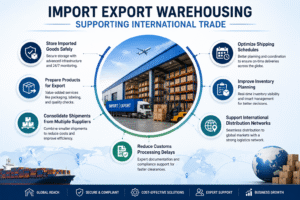
Companies involved in global commerce need specialized import export warehousing solutions that go beyond traditional storage. These facilities help businesses:
- Store imported goods safely
- Prepare products for export
- Consolidate shipments from multiple suppliers
- Reduce customs processing delays
- Optimize shipping schedules
- Improve inventory planning
- Support international distribution networks
Whether importing industrial machinery or exporting finished products, an efficient warehousing strategy helps businesses stay competitive in increasingly demanding global markets often working in tandem with EXIM transport services to keep goods moving between the warehouse and the port.
Why Businesses Prefer Third-Party Warehousing Services
Building and managing a warehouse requires significant investment in infrastructure, technology, staffing, and compliance. This is why many organizations choose third-party logistics services instead, gaining modern infrastructure, experienced logistics professionals, flexible storage capacity, and technology-enabled operations without the capital outlay.
For growing businesses, outsourcing warehousing often provides greater scalability than maintaining dedicated warehouse infrastructure, freeing internal teams to focus on manufacturing, product development, and sales.
Choosing the Right Logistics Partner
Selecting the right warehousing partner is just as important as selecting the right warehouse. A reliable partner should offer more than storage capacity they should understand international trade regulations, customs procedures, inventory optimization, and distribution planning.
When evaluating a logistics partner, consider whether they provide:
- Bonded warehousing expertise
- Access to an FTWZ warehouse in India
- Comprehensive FTWZ logistics services
- Modern warehouse infrastructure and WMS
- Customs compliance support
- Nationwide transportation and distribution
- Industry-specific logistics expertise
For businesses navigating complex regulatory requirements SEZ/EOU closures, DGFT approvals, or multi-jurisdiction compliance working with a specialist in logistics consultancy services alongside your warehousing partner can prevent costly missteps before they happen.
Why Bonded Warehousing and FTWZ Work Better Together
Many businesses mistakenly view bonded warehouses and FTWZ facilities as competing options. In reality, they complement one another.
A bonded warehouse provides customs-controlled storage with deferred duty payments, helping businesses optimize working capital and inventory management. An FTWZ warehouse extends these benefits with value-added logistics services, customs facilitation, and integrated distribution support.
Used together, they create a comprehensive logistics ecosystem that delivers lower logistics costs, improved cash flow, better inventory visibility, simplified customs procedures, faster order fulfillment, and stronger customer service performance rather than a business having to choose one over the other.
Conclusion
As global trade becomes increasingly competitive, businesses need logistics strategies that do more than store inventory; they need solutions that improve cash flow, simplify customs compliance, optimize inventory management, and support seamless domestic and international distribution. This is exactly where a bonded warehouse in India and an FTWZ warehouse in India create long-term business value.
A customs bonded warehouse lets businesses defer import duty payments, giving them greater financial flexibility while improving inventory planning. FTWZ logistics services enhance supply chain performance through packaging, labeling, consolidation, inventory management, and efficient distribution. Combined, these solutions reduce logistics costs, improve operational efficiency, and give businesses greater control over their global supply chains.
Whether you’re an importer, exporter, manufacturer, or distributor, partnering with an experienced logistics provider that understands customs regulations, inventory optimization, and international trade helps build a more agile, cost-effective, and future-ready supply chain.
- A bonded warehouse in India lets businesses store imported goods under customs supervision while deferring duty payments, improving cash flow.
- An FTWZ warehouse extends these benefits with packaging, labeling, inventory management, customs support, and distribution.
- Combining bonded warehousing with FTWZ logistics services creates an efficient ecosystem that reduces costs and strengthens international trade operations.
- Choosing an experienced logistics partner with real customs broking, FTWZ, and consultancy expertise helps businesses build a scalable, compliant supply chain.
Frequently Asked Questions
- What is a bonded warehouse in India?
A bonded warehouse in India is a customs-authorized facility where imported goods can be stored without paying customs duties immediately. Duties are paid only when goods are released into the domestic market, helping businesses improve cash flow and inventory management. - What is the difference between a bonded warehouse and an FTWZ?
A bonded warehouse focuses on customs-controlled storage with deferred duty payments. An FTWZ warehouse offers a broader logistics ecosystem storage, inventory management, packaging, labeling, customs facilitation, and value-added services for international trade. - Who should use bonded warehousing services?
Bonded warehousing is ideal for importers, exporters, manufacturers, wholesalers, retailers, pharmaceutical companies, automotive businesses, electronics manufacturers, and any organization looking to optimize working capital and inventory. - What are FTWZ logistics services?
FTWZ logistics services include warehousing, customs documentation, cargo consolidation, packaging, repackaging, labeling, inventory management, distribution, quality inspection, and export processing within a Free Trade and Warehousing Zone. - How do integrated warehousing solutions improve supply chain efficiency?
They combine storage, transportation, customs coordination, WMS, inventory visibility, and distribution into one streamlined operation reducing logistics costs and accelerating order fulfillment. - What is a customs bonded warehouse?
A licensed warehouse operating under customs supervision, where imported goods can be stored before duties are paid or before goods are re-exported. - Why are third-party warehousing services beneficial?
They reduce infrastructure costs, improve operational flexibility, provide access to advanced warehouse technology, and let businesses scale storage capacity without capital investment. - What is import export warehousing?
Specialized storage facilities designed to support businesses in international trade managing imported goods, export shipments, inventory consolidation, customs compliance, and global distribution. - How do warehousing and distribution services benefit businesses?
They ensure products move efficiently from warehouse to customer or distribution center improving inventory accuracy, reducing transportation costs, and shortening delivery timelines. - How can FTWZ and bonded warehouses work together?
Businesses often combine both bonded warehouses, defer customs duties and optimize inventory, while FTWZ facilities add value-added logistics services and international distribution support, creating a more flexible, cost-effective supply chain.
- A bonded warehouse in India lets businesses store imported goods under customs supervision while deferring duty payments, improving cash flow.
- An FTWZ warehouse extends these benefits with packaging, labeling, inventory management, customs support, and distribution.
- Combining bonded warehousing with FTWZ logistics services creates an efficient ecosystem that reduces costs and strengthens international trade operations.
- Choosing an experienced logistics partner with real customs broking, FTWZ, and consultancy expertise helps businesses build a scalable, compliant supply chain.