Union Budget 2026 arrives at a defining moment for the global economy. International trade is undergoing rapid transformation due to geopolitical tensions, supply chain restructuring, slowing global growth, and evolving economic alliances. For a trade-dependent economy like India, these changing conditions demand a carefully balanced fiscal and trade strategy.
Against this backdrop, Union Budget 2026 places strong emphasis on global trade winds, tariff harvesting, and targeted policy reforms. The objective is clear: strengthen India’s global competitiveness while protecting domestic manufacturing, supporting MSMEs, and minimizing the impact on consumers.
This budget reflects India’s intent to remain agile in a volatile global environment while laying the foundation for long-term economic resilience.
Understanding Changing Global Trade Winds
Global trade winds refer to the shifting patterns of international trade influenced by political, economic, and technological factors. Over the past few years, global trade has been shaped by:
- Geopolitical conflicts and regional instability
- Supply chain disruptions and near-shoring strategies
- Protectionist trade policies
- Inflation and interest rate volatility
- Reconfiguration of trade alliances
These factors have significantly reshaped international trade and tariffs, forcing countries to rethink their trade dependencies and economic priorities.
Under Union Budget 2026, India recognizes these realities and recalibrates its India global trade policy to remain competitive and resilient. The government’s strategy focuses on:
- Reducing dependency on select markets by diversifying trade partners
- Encouraging export diversification across sectors and regions
- Strengthening domestic manufacturing competitiveness through supportive policies
This approach ensures that India continues to participate actively in global supply chains while reducing vulnerability to external shocks.
What Is Tariff Harvesting in Union Budget 2026?
Tariff harvesting is a strategic policy approach where import and export duties are selectively adjusted to achieve economic, industrial, and fiscal objectives. Instead of blanket tariff increases, the government uses duties as a calibrated tool to influence production, trade flows, and revenue generation.
In Union Budget 2026, tariff harvesting is used to:
- Protect domestic industries from unfair global competition
- Encourage local manufacturing and value addition
- Optimize government revenue without placing excessive burden on consumers
This approach signals a shift away from reactionary tariff changes toward a more structured and long-term trade strategy. By focusing on selective duty rationalization, the budget aims to enhance trade efficiency while maintaining fiscal discipline.
Customs Duty Changes 2026: A Strategic Shift
One of the major Union Budget 2026 highlights is the recalibration of customs duty changes 2026 across key sectors of the economy. These changes are designed to balance domestic manufacturing needs with global competitiveness.
Key objectives behind these changes include:
- Reducing duties on critical raw materials required for domestic production
- Rationalizing import export tariffs in India to simplify trade structures
- Encouraging domestic value addition rather than reliance on finished goods imports
By lowering input costs and simplifying tariff structures, the government supports manufacturers, exporters, and supply-chain-dependent industries. This directly strengthens the export import policy India 2026, making Indian goods more competitive in global markets while managing import dependence more efficiently.
Union Budget 2026 Trade Reforms and Policy Direction
The Union Budget 2026 trade reforms focus on policy stability, predictability, and long-term planning key requirements for attracting investment and enabling sustainable growth.
Rather than frequent regulatory changes, the government outlines a consistent roadmap that prioritizes:
- Trade facilitation through faster clearances and simplified documentation
- Streamlined customs procedures to reduce transaction costs
- Digital trade compliance systems to improve transparency and efficiency
These measures strengthen the trade policy impact on India, enhance ease of doing business, and improve India’s credibility as a reliable trading partner.
Economic Impact of Union Budget 2026
The economic impact of Union Budget 2026 extends beyond trade numbers and customs duties. By aligning tariff policy with industrial and economic goals, the budget aims to create a balanced growth environment.
Key economic objectives include:
- Boosting domestic production and employment through manufacturing incentives
- Controlling inflationary pressures by managing import costs effectively
- Improving export competitiveness across multiple sectors
A well-calibrated government tariff policy India ensures that economic growth is supported without placing undue stress on businesses or consumers.
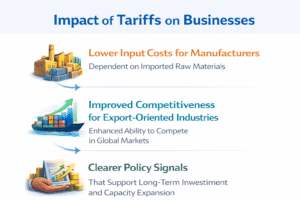
Impact of Tariffs on Businesses
For businesses – particularly those involved in manufacturing, exports, and supply-chain-intensive operations – tariff policies have a direct impact on costs and profitability.
Under Union Budget 2026, the impact of tariffs on businesses includes:
- Lower input costs for manufacturers dependent on imported raw materials
- Improved competitiveness for export-oriented industries
- Clearer policy signals that support long-term investment and capacity expansion
By providing stability and predictability, the budget encourages businesses to plan for growth rather than react to policy uncertainty.
MSME Impact of Union Budget 2026
The MSME impact of Union Budget 2026 is especially significant, as smaller enterprises are often more sensitive to changes in tariffs and compliance requirements.
The budget supports MSMEs by:
- Lowering duties on essential production inputs
- Improving access to export markets through trade facilitation measures
- Simplifying compliance and regulatory processes
These steps strengthen MSMEs’ participation in international trade and enhance their role in India’s export ecosystem, helping them scale operations and improve competitiveness.
Effect of Tariffs on Consumers
Tariff policies ultimately influence consumer prices. The effect of tariffs on consumers in Union Budget 2026 has been carefully managed to avoid inflationary shocks.
Key consumer-focused outcomes include:
- Stable pricing for essential and everyday goods
- Limited pass-through of import costs to retail prices
- Improved availability of critical goods
By balancing tariff adjustments with inflation control measures, the budget protects consumer interests while maintaining fiscal and trade discipline.
Budget Impact on Trade and Economy
The overall budget impact on trade and economy reflects India’s strategic intent to align fiscal policy with evolving global realities. The key goals include:
- Strengthening export competitiveness
- Encouraging domestic manufacturing and value chains
- Ensuring fiscal policy aligns with global trade trends
By responding proactively to changing global trade winds, Union Budget 2026 positions India as a resilient and adaptive economic player.
India’s Global Trade Outlook After Union Budget 2026
Looking ahead, India’s trade outlook will depend on how effectively these policies are implemented. With focused reforms, rational tariffs, and active global engagement, Union Budget 2026 lays the groundwork for:
- Sustainable export growth
- Stable and diversified trade relations
- Improved long-term economic resilience
Successful execution will determine India’s ability to navigate global uncertainties while sustaining domestic growth.
Conclusion
Union Budget 2026 presents a pragmatic and forward-looking response to global trade challenges. By aligning tariff harvesting, customs duty rationalization, and trade reforms with broader economic priorities, the budget strikes a balance between growth, competitiveness, and stability.
As global trade winds continue to evolve, India’s adaptive policy framework under Union Budget 2026 positions the economy to respond confidently to both emerging challenges and long-term opportunities.
Resources
To better understand the policy context, trade framework, and economic direction discussed in this article, readers can refer to the following authoritative sources:
- Union Budget – Government of India
Official budget documents and policy direction related to trade, tariffs, and fiscal measures. - Ministry of Commerce & Industry, India
Updates on India’s global trade policy, export–import reforms, and international trade initiatives. - Central Board of Indirect Taxes & Customs (CBIC)
Information on customs duty changes, tariff structures, and trade compliance. - World Trade Organization (WTO)
Global trade trends, tariff policies, and international trade dynamics. - Policy & Economic Analysis Reports (KPMG, RBI, etc.)
Independent analysis and expert insights on budget impact and economic reforms.
FAQs
- What is the main focus of Union Budget 2026 on trade?
Union Budget 2026 focuses on managing global trade winds, optimizing tariffs, and strengthening India’s export competitiveness. - What does tariff harvesting mean in Union Budget 2026?
Tariff harvesting refers to selective duty adjustments aimed at protecting domestic industries while improving trade efficiency. - How do customs duty changes 2026 affect businesses?
They reduce input costs, improve export competitiveness, and provide policy stability for long-term planning. - What is the MSME impact of Union Budget 2026?
MSMEs benefit from lower input duties, better export access, and simplified compliance requirements. - How does the Union Budget 2026 impact consumers?
The budget minimizes inflationary pressure by rationalizing tariffs on essential goods and stabilizing prices.