In today’s highly competitive and interconnected global market, businesses are under constant pressure to deliver products faster, reduce operational costs, and maintain complete transparency across their supply networks. Customers now expect real-time updates, shorter delivery windows, and consistent service quality, regardless of location. At the same time, rising fuel costs, labor shortages, and global disruptions are increasing operational complexity.
This environment has made logistics management optimization a critical business strategy rather than a back-end operational task. Organizations that proactively optimize their logistics processes gain a clear competitive advantage in supply chain efficiency, scalability, and customer satisfaction. Instead of reacting to delays or disruptions, optimized logistics systems allow businesses to plan, predict, and perform with greater control.
Logistics optimization focuses on improving how goods, information, and resources move across the supply chain. By applying the right logistics optimization techniques, companies can streamline operations, minimize waste, and respond quickly to changing market demands while maintaining profitability.
What Is Logistics Management Optimization?
Logistics management optimization is the systematic process of improving logistics activities such as transportation, warehousing, inventory control, and distribution to achieve higher operational efficiency and service reliability. The goal is to ensure that products reach the right destination, at the right time, and at the lowest possible cost without compromising quality or customer experience.
Traditionally, logistics optimization focused primarily on cost reduction in logistics. While cost control remains important, modern optimization strategies go much further. Today, businesses prioritize agility, responsiveness, sustainability, and real-time visibility. Optimization now means creating a logistics ecosystem that can adapt quickly to demand fluctuations, supply disruptions, and evolving customer expectations.
When executed correctly, logistics management optimization becomes a growth enabler, not just an operational improvement.
Key Logistics Optimization Techniques in Modern Supply Chains
1. Transportation Optimization
Transportation optimization is one of the most impactful areas of logistics improvement. It focuses on reducing freight costs, improving delivery speed, and maximizing vehicle and carrier utilization. Transportation often accounts for the largest share of logistics expenses, making it a priority for optimization initiatives.
By analyzing shipment volumes, carrier performance, delivery timelines, and cost structures, businesses can select the most efficient transportation modes and routes. Consolidating shipments, optimizing load planning, and selecting the right carrier mix can significantly improve delivery reliability while lowering operational costs.
Transportation optimization directly contributes to improved customer satisfaction by ensuring consistent and predictable delivery schedules.
2. Route Optimization in Logistics
Route optimization in logistics ensures that delivery vehicles follow the most efficient paths based on distance, traffic conditions, delivery windows, vehicle capacity, and fuel consumption. Advanced route planning reduces unnecessary mileage, idle time, and missed delivery slots.
Optimized routing not only improves on-time delivery rates but also supports cost reduction in logistics by lowering fuel usage and vehicle wear and tear. Additionally, efficient routing contributes to sustainability goals by reducing carbon emissions—an increasingly important factor for modern supply chains.
For last-mile delivery operations, route optimization plays a critical role in balancing speed, cost, and customer expectations.
3. Warehouse Optimization
Efficient warehouses are the backbone of high-performing supply chains. Warehouse optimization focuses on improving layout design, storage utilization, picking accuracy, and order fulfillment speed. Poorly designed warehouses often lead to bottlenecks, delays, and high labor costs.
Optimized warehouse operations reduce handling errors, shorten order processing times, and improve workforce productivity. Technologies such as barcode scanning, warehouse management systems (WMS), and automation tools help streamline operations and improve accuracy.
A well-optimized warehouse ensures smooth inventory flow and acts as a stabilizing force during demand surges.
4. Inventory Optimization
Inventory optimization balances product availability with carrying costs. Holding too much inventory ties up working capital and increases storage expenses, while insufficient inventory leads to stockouts and lost sales.
By leveraging accurate demand forecasting and historical data, businesses can maintain optimal inventory levels across locations. Inventory optimization supports better planning, reduces waste, and improves service levels especially in multi-channel and omnichannel supply chains.
When inventory optimization is aligned with warehouse and transportation strategies, overall supply chain efficiency improves significantly.
Role of Technology in Logistics Optimization
Technology has transformed logistics from a reactive function into a proactive, predictive, and data-driven discipline. Modern supply chains rely heavily on digital tools to manage complexity and scale operations efficiently.
Digital Logistics Solutions
Digital logistics solutions provide centralized platforms for managing transportation, warehousing, and inventory in real time. These systems integrate data across the supply chain, enabling seamless coordination between stakeholders.
One of the most valuable outcomes of digitalization is enhanced supply chain visibility. Businesses can track shipments, monitor inventory levels, and identify potential disruptions instantly. This visibility enables faster decision-making and better risk management.
Logistics Automation
Through logistics automation, repetitive and manual tasks such as order processing, labeling, inventory updates, and shipment tracking are streamlined. Automation reduces human error, increases processing speed, and ensures consistency across operations.
Automated workflows also free up human resources to focus on strategic planning and problem-solving, rather than routine administrative tasks.
Data-Driven Logistics
Data-driven logistics uses analytics and performance metrics to guide decision-making. By analyzing historical data, real-time tracking information, and predictive insights, organizations can optimize routes, forecast demand, and measure logistics performance improvement over time.
Key performance indicators (KPIs) such as delivery accuracy, order cycle time, and cost per shipment help businesses continuously refine their logistics strategies.
AI in Logistics Optimization
The adoption of AI in logistics optimization has introduced a new level of intelligence into supply chain operations. AI-powered systems can predict demand patterns, recommend optimal routes, and anticipate potential disruptions before they occur.
AI also enables predictive maintenance for fleets, intelligent warehouse automation, and dynamic delivery scheduling. As a result, businesses can move from reactive problem-solving to proactive optimization.
Benefits of Logistics Management Optimization
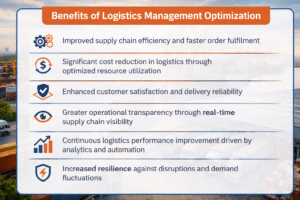
Implementing effective logistics optimization strategies delivers measurable and long-term business value:
- Improved supply chain efficiency and faster order fulfillment
- Significant cost reduction in logistics through optimized resource utilization
- Enhanced customer satisfaction and delivery reliability
- Greater operational transparency through real-time supply chain visibility
- Continuous logistics performance improvement driven by analytics and automation
- Increased resilience against disruptions and demand fluctuations
These benefits collectively strengthen a company’s market position and profitability.
Best Practices for Logistics Management
To achieve sustainable results, organizations should follow proven best practices for logistics management:
- Integrate logistics systems across transportation, warehousing, and inventory functions
- Use KPIs and dashboards to monitor cost, service quality, and delivery performance
- Invest in automation, AI, and digital platforms
- Collaborate closely with suppliers, carriers, and logistics partners
- Continuously refine processes using data insights and performance reviews
When these practices are aligned, businesses can achieve true end-to-end supply chain optimization, ensuring seamless coordination from sourcing and storage to final delivery.
Conclusion
Logistics optimization is no longer optional; it is a strategic necessity for modern supply chains. As complexity increases and customer expectations rise, businesses must move beyond traditional logistics models and embrace logistics management optimization as a core capability.
By leveraging technology, applying data-driven strategies, and adopting best practices across transportation, warehousing, and inventory management, organizations can build agile, cost-efficient, and resilient logistics networks. Companies that invest in optimization today are far better positioned to scale, adapt, and compete in an increasingly dynamic global market.
FAQs
1. What is logistics management optimization?
Logistics management optimization is the process of improving transportation, warehousing, inventory, and distribution operations to reduce costs, increase efficiency, and enhance overall supply chain performance.
2. How do logistics optimization techniques improve supply chain efficiency?
Logistics optimization techniques streamline processes such as transportation planning, route optimization, inventory control, and warehouse management, resulting in faster deliveries and reduced operational waste.
3. What role does technology play in logistics optimization?
Technology enables digital logistics solutions, automation, AI, and data-driven logistics, helping businesses gain supply chain visibility, predict demand, and improve decision-making.
4. How does route optimization help reduce logistics costs?
Route optimization in logistics minimizes fuel consumption, delivery time, and vehicle usage by identifying the most efficient delivery routes, leading to significant cost reduction in logistics.
5. What is end-to-end supply chain optimization?
End-to-end supply chain optimization focuses on optimizing every stage of logistics from sourcing and inventory storage to transportation and final delivery for seamless and efficient operations.