When comparing FTWZ vs Regular Warehousing, businesses involved in international trade must look beyond storage costs. The right warehousing model can directly impact customs duty payments, working capital, supply chain efficiency, and global expansion opportunities.
In India, companies are increasingly choosing a Free Trade Warehousing Zone in India to streamline imports and exports while reducing operational bottlenecks. But how exactly does FTWZ differ from traditional warehousing? And why is it becoming a preferred model for importers and exporters?
Let’s break it down clearly.
What is FTWZ in India?
A Free Trade Warehousing Zone (FTWZ) is a special category of warehouse located within a designated free trade zone. It allows goods to be stored without immediate payment of customs duty. Duty is paid only when goods enter the domestic market.
Unlike regular warehouses, FTWZ facilities operate under customs supervision and provide additional trade benefits such as:
- Duty deferment
- Re-export without duty payment
- Value-added services
- Consolidation and redistribution
This model supports global trade flexibility while improving cash flow.
What is Regular Warehousing?
Regular warehousing refers to traditional storage facilities where imported goods typically require customs clearance and duty payment before storage or distribution.
These warehouses:
- Do not offer duty deferment
- Do not allow easy re-export without duty implications
- Are primarily used for domestic storage and distribution
While they are suitable for local supply chains, they lack the strategic trade advantages offered by FTWZ warehousing solutions.
FTWZ vs Regular Warehousing: Key Differences
Here’s a clear comparison to understand the difference between FTWZ and warehouse models:
| Feature | FTWZ | Regular Warehousing |
| Customs Duty Payment | Deferred until goods enter domestic market | Paid upfront |
| Re-export | No duty required | Duty complications apply |
| International Trading | Allowed | Limited |
| Value-added Services | Permitted | Limited |
| Supply Chain Flexibility | High | Moderate |
| Ideal for | Importers & exporters | Domestic distributors |
From a strategic standpoint, FTWZ offers far greater flexibility for businesses engaged in international trade.
FTWZ vs Bonded Warehouse: Are They the Same?
Many businesses also compare FTWZ vs bonded warehouse facilities.
While both allow duty deferment, FTWZ provides additional benefits such as:
- Permission for value-added activities
- Better infrastructure within trade zones
- International trading and redistribution support
- Enhanced logistics ecosystem
Bonded warehouses mainly focus on storage under customs bond, whereas FTWZ supports comprehensive trade operations.
Top FTWZ Benefits for Businesses
The growing popularity of FTWZ warehousing solutions is driven by strong operational and financial advantages.
1. Improved Cash Flow
Since customs duty is paid only when goods enter the Indian market, businesses preserve working capital.
2. Re-export Without Duty Burden
If goods are re-exported directly from FTWZ, no customs duty is applicable.
3. Supply Chain Optimization
FTWZ facilities help consolidate shipments, manage inventory strategically, and improve global distribution efficiency.
4. Value-Added Services
Activities such as labeling, packaging, repacking, and minor processing are permitted.
5. Strategic Location Advantage
Many businesses prefer FTWZ services in Mumbai, especially FTWZ near JNPT, due to direct port connectivity and global trade access.
FTWZ Advantages for Importers
For importers, FTWZ offers significant operational advantages:
- Bulk import and gradual domestic clearance
- Reduced financial pressure
- Inventory holding flexibility
- Lower overall logistics costs
This makes FTWZ particularly attractive for industries like electronics, automotive parts, pharmaceuticals, and consumer goods.
Why Choose FTWZ Services in Mumbai?
Mumbai is a major logistics hub, and proximity to JNPT (Jawaharlal Nehru Port) — Jawaharlal Nehru Port – makes it strategically ideal for international trade.
Businesses looking for FTWZ near JNPT benefit from:
- Faster cargo movement
- Reduced inland transportation cost
- Efficient port connectivity
- Strong customs infrastructure
Partnering with an experienced FTWZ logistics provider India ensures compliance, smooth customs handling, and optimized storage solutions.
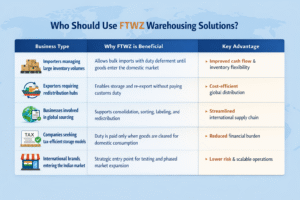
Who Should Use FTWZ Warehousing Solutions?
FTWZ is ideal for:
- Importers managing large inventory volumes
- Exporters requiring redistribution hubs
- Businesses involved in global sourcing
- Companies seeking tax-efficient storage models
- International brands entering the Indian market
If your business deals with cross-border trade, a Free Trade Zone warehousing services model offers scalability and flexibility.
How FTWZ Improves Overall Supply Chain Strategy
Modern supply chains demand agility. FTWZ warehousing solutions help businesses:
- Centralize inventory
- Delay duty payments strategically
- Reduce compliance risks
- Improve global distribution efficiency
Instead of locking capital in upfront duty payments, companies can invest in expansion and market growth.
Is FTWZ Better Than Regular Warehousing?
For domestic-only businesses, regular warehousing may suffice. However, for import-export companies, the answer is clear.
When comparing FTWZ vs Regular Warehousing, FTWZ delivers:
Financial efficiency
Operational flexibility
Global trade support
Risk reduction
Strategic location benefits
In a competitive international trade environment, these advantages can significantly impact profitability.
Conclusion
Understanding the difference between FTWZ and warehouse models is critical for businesses involved in global trade. While traditional warehousing serves domestic distribution needs, a Free Trade Warehousing Zone in India provides customs flexibility, improved cash flow, and long-term supply chain advantages.
For companies looking to scale operations, reduce customs burden, and optimize logistics, choosing the right FTWZ logistics provider India, especially one offering FTWZ services in Mumbai near JNPT can be a strategic game-changer.
If your goal is efficient international trade operations, FTWZ is not just an option, it’s a competitive advantage.
FAQs
1. What is the main difference between FTWZ vs Regular Warehousing?
FTWZ allows duty deferment and international trade activities, while regular warehousing requires upfront duty payment and mainly supports domestic distribution
2. What are the key FTWZ benefits for importers?
FTWZ benefits include improved cash flow, duty deferment, re-export flexibility, and value-added services under customs supervision.
3. How is FTWZ different from a bonded warehouse?
In FTWZ vs bonded warehouse comparison, FTWZ offers broader trade benefits including redistribution, processing permissions, and advanced infrastructure
4. Why choose FTWZ services in Mumbai?
Mumbai offers proximity to JNPT, efficient port connectivity, and strong customs infrastructure, making it ideal for international trade operations.
5. Who should use a Free Trade Warehousing Zone in India?
Importers, exporters, multinational companies, and businesses involved in cross-border trade benefit the most from FTWZ warehousing solutions.